AspectKey Findings
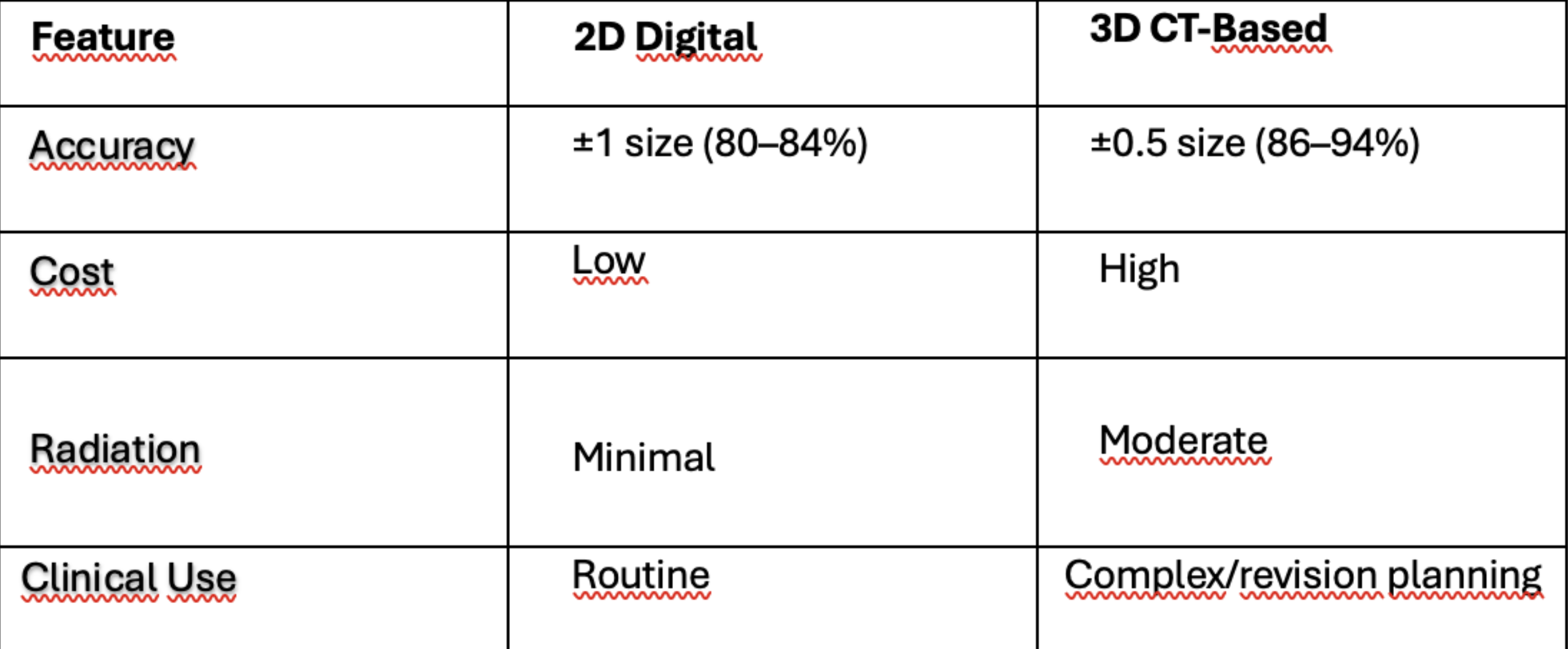
Accuracy : Predicts component size within one size of the final implant in most cases.
Alignment & Function: No consistent effect on postoperative alignment, ROM, or PROMs.
Efficiency: Adds cost and time (software, licensing, training).
Alternatives: Demographic-based models (height, sex, BMI) predict size equally well.
Clinical Use: Best suited for inventory and surgical planning, not for outcome prediction.
Tip: Use templating as a preoperative checklist tool, not as a strict sizing determinant.
Clinical Implications
Digital templating is a useful planning adjunct but not an outcome determinant.
Demographic prediction models may replace templating in routine TKA workflows.
Integration with AI-based morphometrics could improve predictive precision.
Clinical Relevance
Standardized imaging protocols (AP pelvis with centered scaling ball) are essential for reproducible THA planning.
Digital templating reduces operative time, implant mismatch, and intraoperative guesswork.
TKA templating, while less predictive of functional outcome, assists in logistics and implant preparation.
In both THA and TKA, templating accuracy improves with experience, consistent magnification calibration, and software familiarity.
Emerging AI-assisted 3D templating is likely to redefine precision planning and patient-specific arthroplasty.
Clinical Pearl:
Calibration marker placed at hip joint level (not on the table) prevents oversizing — a small detail that avoids major intraoperative complications.
Common Pitfalls
Oversized components due to miscalibrated images → higher fracture risk. Ignoring 3D bone morphology in dysplastic or post- traumatic hips → malposition risk.
Excessive reliance on digital software without radiographic standardization → poor reproducibility.
References
Kothari M, et al. Digital Templating for Total Hip Arthroplasty: Accuracy and Clinical Relevance. J Arthroplasty. 2023.
O’Neill S, et al. Evaluation of Calibration Marker Position in THA Templating. Bone Joint J. 2022;104-B(6):742–749.
Sunil T, et al. Digital Templating Accuracy in Total Knee Arthroplasty. Cureus. 2024;16:e48720.
MacDessi SJ, et al. 2D vs 3D Preoperative Planning in Arthroplasty. Bone Joint J. 2024.
Guyen O, et al. Calibration and Digital Planning in Modern Hip Surgery. J Arthroplasty. 2023.