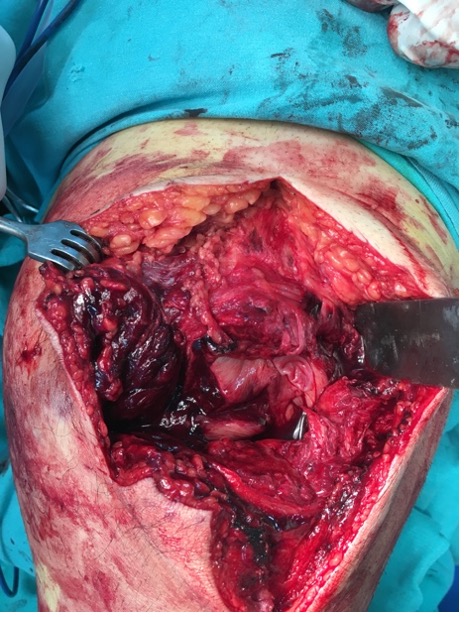
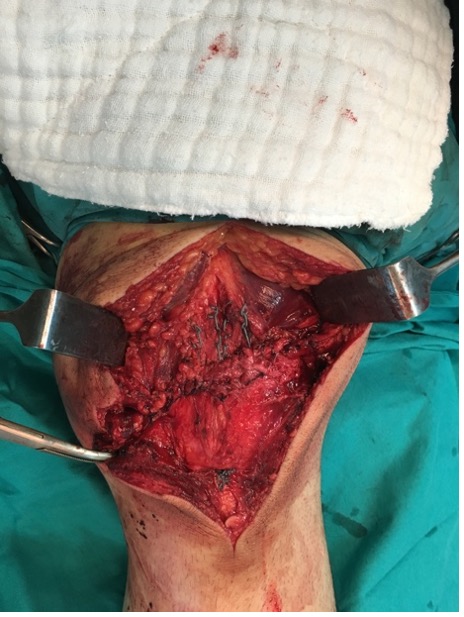
Overview
Patellar tendon ruptures- generally in active individuals under 40 years of age,
Quadriceps tendon ruptures-frequently in individuals over 40 years of age.
Ruptures of the quadriceps tendon- eight times more frequently in males than in females.
Due to a fast eccentric contraction of the quadriceps when the knee is flexed.
Likely a consequence of chronic tendon deterioration following recurrent microtrauma to the knee and is usually unilateral.
Ruptures of the quadriceps tendon- More frequently observed in people with preexisting medical conditions. (Systemic conditions, including autoimmune diseases, diabetes mellitus, renal disease, obesity, and prolonged corticosteroid usage)
Clinical Presentation
Intense pain, a tearing or popping feeling in the knee, an inability to actively extend the knee or sustain complete knee extension against gravity,
Swelling, and a palpable gap in the suprapatellar (quadriceps tendon) or infrapatellar (patellar tendon) regions.
Imaging
Lateral knee radiographs
· Patellar tendon rupture: Patella alta, tibial tubercle avulsion, patella inferior pole avulsion,
· Quadriceps tendon rupture: Patella baja, suprapatellar calcification, avulsion of a patella bony fragment, patellar spurs, dystrophic calcification
Magnetic Resonance Imaging: Differentiate between complete and incomplete ruptures and provide further information about the intra-articular condition of the knee.
Ultrasonography: Cost-effective and easily accessible, but it is dependent upon the operator's expertise..
Treatment
Small partial tears of tendons may be managed nonoperatively-a period of immobilization in extension for several weeks, followed by a progressive increase in passive flexion,. Strengthening exercises can start after a duration of six weeks.
Acute complete tears- surgical intervention. Transoseeous repair or repair with suture anchor may be used. Mid-substance tears require end to end repair and augmentation. Augmentation- tendon grafts, synthetic tapes or cerclage wires.
Chronic ruptures- require augmentation with autografts or allografts. The hamstrings are the most frequently utilized tendons.
Local turndown flaps derived from the quadriceps tendon (Codivilla technique) and Scuderi type V-Y plasty for tendon lengthening may be necessary in cases with chronic quadriceps ruptures.
Allografts are recommended for individuals with chronic defects
Prognosis
The outcomes of early repairs -almost 90% and functional recovery between 80% and 90%.
Return to play rates nearly 90% in athletes following primary repair.
The surgical treatment of chronic ruptures shows worse outcomes than acute ruptures.
Differential diagnosis
Femoral nerve palsy
References
Vidil A, Ouaknine M, Anract P, Tomeno B. Trauma-induced tears of the quadriceps tendon: 47 cases. Rev Chir Orthop Reparatrice Appar Mot 2004;90 (February (1)):40–8.
Hak DJ, Sanchez A, Trobisch P. Quadriceps tendon injuries. Orthopedics 2010;33(January (1)):40–6.
Carlson Strother CR, LaPrade MD, Keyt LK, Wilbur RR, Krych AJ & Stuart MJ. A strategy for repair, augmentation, and reconstruction of knee extensor mechanism disruption: a retrospective review. Orthopaedic Journal of Sports Medicine 2021 9 23259671211046625. (https://doi.org/10.1177/23259671211046625)
Tandogan, R. N., Terzi, E., Gomez-Barrena, E., Violante, B., & Kayaalp, A. (2022). Extensor mechanism ruptures. EFORT Open Reviews, 7(6), 384-395. Retrieved Aug 31, 2025, from https://doi.org/10.1530/EOR-22-0021
Rougraff BT, Reeck CC, Essenmacher J. Complete quadriceps tendon ruptures. Orthopedics 1996;19(June (6)):509–14.
Haskel JD, Fried JW, Hurley ET, Mojica ES, Alaia MJ, Strauss EJ & Campbell KA. High rates of return to play and work follow knee extensor tendon ruptures but low rate of return to pre-injury level of play. Knee Surgery, Sports Traumatology, Arthroscopy 2021 29 2695–2700. (https://doi.org/10.1007/s00167-021-06537-4)