Overview
Called tendinitis and its clinical picture is similar to Osgood-Schaltter disease.The main difference is that the localized tenderness is at the inferior end of the patella, not at the tibial tubercle.1**
Symptoms generally result from chronic overuse of the extensor mechanism. Excessive flexion of the knee may result in partial ligament injury and avulsion, associated calcification, or a stress fracture of the distal patella. Fragmentation of the lower end of the patella or patella alta may be observed in patients.
Etyology
The condition has been reported to be more common in growing children who participate in sports involving jumping. During the acceleration phase before jumping, the knee is forced into valgus and internal rotation, causing significant shortening of the hip flexors, adductors, and knee extensors. As a result of these biomechanical changes during jumping, excessive loads are placed on the patellofemoral region and patellar apices, and as this load becomes chronic, symptoms begin to appear in the patient.2**
Presentation
Commonly seen in children aged 8-15 years.
Extreme increase in pain after an acute trauma.
Patients complaints of anterior knee pain, which increases with jumping, running, climbing stairs, and sitting for long periods of time.
Imaging
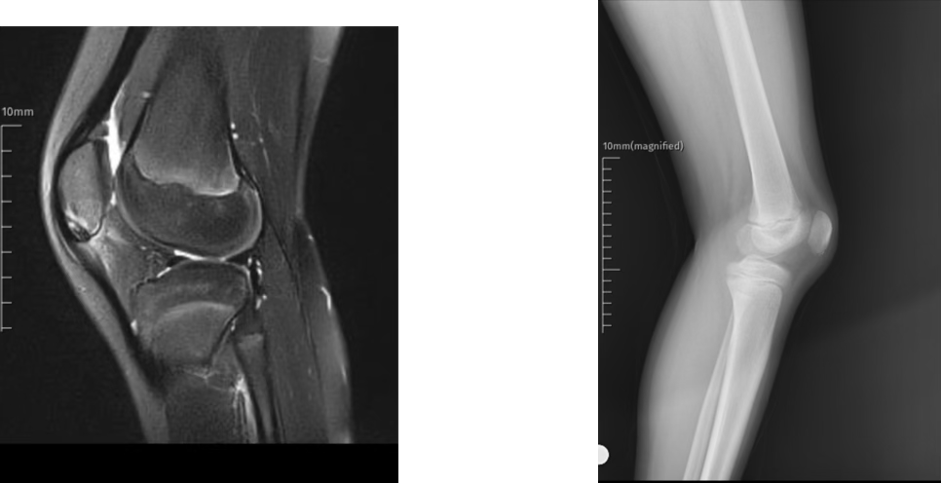
Lateral radiographs of the knee may reveal bone avulsion, irregular soft tissue calcification at the distal end of the patella, or patellar tendon elongation.
When there is pain and swelling in the superior or inferior aspect of the patella but no radiographic findings, a partial ligament injury should be suspected. Such injuries can be easily distinguished from other pathologies with magnetic resonance imaging or ultrasonography.
Treatment
Self-limiting pathology with activity modification and anti-inflammatory treatment.
Treatment of overuse injuries basically consists of physical therapy with stretching and strengthening exercises against passive resistance after rest.
In cases where chronic symptoms increase after acute trauma, supportive treatment can be arranged with a 4-6 week rest period and orthoses to help with rest.Rehabilitation programs have a success rate of up to 90% in chronic tendinopathies.3**
In adolescents whose growth is about to be completed, in cases of pain that does not respond to conservative treatment, successful surgical treatment can be applied by debridement and, if necessary, excision of the inflamed focus causing the pain.
Symptoms disappear after approximately 1 year and are very rare after skeletal maturation.
References:
1**Medlar RC, Lyne ED. Sinding-Larsen-Johansson disease. Its etiology and natural history. J Bone Joint Surg [Am] 1978;60:1113-6.
2**Lau LL, Mahadev A, Hui JH. Common lower limb sport- related overuse injuries in young athletes. Ann Acad Med Singapore 2008;37:315-9.
3**Stanish WD, Rubinovich RM, Curwin S. Eccentric exercise in chronic tendinitis. Clin Orthop Relat Res 1986;208:65-8.