Overview
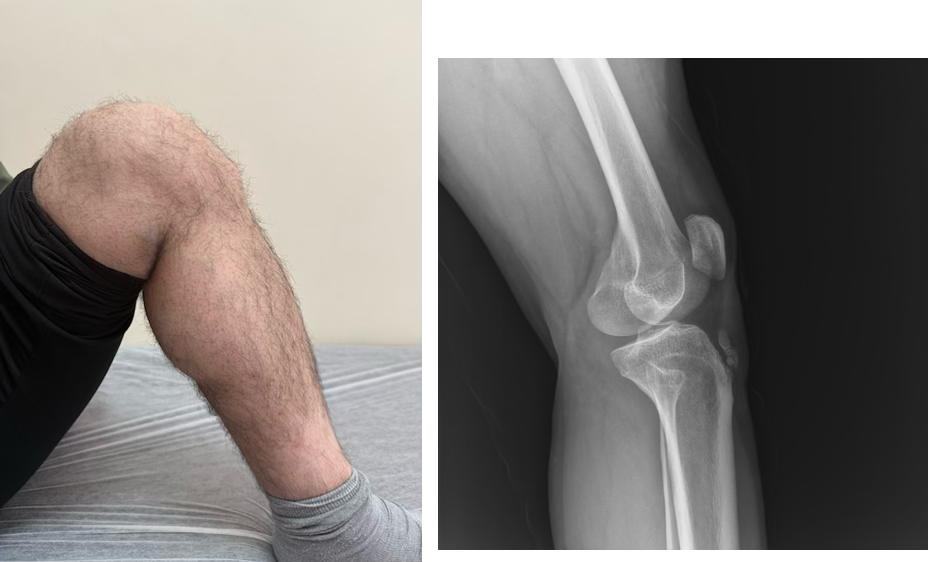
The normal healing tissue formed in response to chronic avulsion injury and the resulting extremely painful and prominent tibial tubercle are characteristic of the disease.The onset of symptoms is closely related to sporting activities.
Skeletal development and activity level are more closely related to the development
Patients are usually between the ages of 10 and 14, and 30% of them are bilateral.
Adolescents with short rectus femoris muscles may experience traction apophysitis, which is common with increased sports activity.1**
It is caused by repetitive traction of the patellar tendon over the ossification center or apophysis at the tibial tubercle.
Predisposing factors include poor flexibility of quadriceps and hamstrings or other evidence of extensor mechanism misalignment
Risk factors
Male gender, ages: male 12-15, girls 8-12, sudden skeletal growth, repetitive activities like jumping and sprinting.
Phisycal examination
Swollen and painful tibial tubercle, pain during knee extension against resistance and often signs of extension insufficiency .
Positive Ely test indicates a tight quadriceps muscle.
An increased Q angle and patella alta are also frequently present.
Pathophysiology
The tibial tubercle develops as a secondary ossification center that provides attachment for the patellar tendon. Bone growth exceeds the ability of the muscle-tendon unit to stretch sufficiently to maintain previous flexibility leading to increased tension across the apophysis. The physis is the weakest point in the muscle-tendon-bone-attachment (as opposed to the tendon in an adult) and therefore, at risk of injury from repetitive stress. With repeated contraction of the quadriceps muscle mass, especially with repeated forced knee extension as seen in sports requiring running and jumping (basketball, football, gymnastics), softening and partial avulsion of the apophyseal ossification center may occur with a resulting osteochondritis
Diagnosis
Diagnosis often made clinically.
Radiography
Useful to exclude fractures, tumors, and osteomyelitis.
Also typically reveal soft tissue edema and tubercle elevation.
Fragmentation at the ossification center is not a reliable finding because the bony ossification of the tibial tubercle is quite variable.2*
Treatment
Determined by the duration of symptoms and the patient's skeletal age.
Initially, rest and ice application significantly reduce movement limitation and pain. no evidence to suggest that rest speeds up recovery, but activity restriction is effective in reducing pain.Painkillers may be started.
Crucial to begin stretching and strengthening exercises for the quadriceps muscle.
Straight leg raises with increasing weight against resistance are beneficial. patellar tendon tapes as an assistive device reduces the load on the tibial tuberosity.
Long-term sequelae may include a thickened or prominent tibial tubercle, but this is asymptomatic in the vast majority of cases.
Local corticosteroid injection is not recommended due to potential skin problems.3*
As a result of inadequate treatment, approximately 30% of patients may require surgical intervention.4* Significant relief can be achieved in patients with excision of free ossicles and debridement of the tibial tubercle.5*
Using arthroscopic surgery avoids patellar tendon transection and allows for better clarification of intra-articular pathologies.6*
1* de Lucena GL, dos Santos Gomes C, Guerra RO. Prevalence and associated factors of Osgood-Schlatter syndrome in a population-based sample of Brazilian adolescents. Am J Sports Med 2011;39:415-20.
2* Thabit G 3rd, Micheli LJ. Patellofemoral pain in the pediatric patient. Orthop Clin North Am 1992;23:567-85.
3* Rostron PK, Calver RF. Subcutaneous atrophy following methylprednisolone injection in Osgood-Schlatter epiphysitis. J Bone Joint Surg [Am] 1979;61:627-8.
4* Kujala UM, Kvist M, Heinonen O. Osgood-Schlatter's disease in adolescent athletes. Retrospective study of incidence and duration. Am J Sports Med 1985;13:236-41.
5* Weiss JM, Jordan SS, Andersen JS, Lee BM, Kocher M. Surgical treatment of unresolved Osgood-Schlatter disease: ossicle resection with tibial tubercleplasty. J Pediatr Orthop 2007;27:844-7.
6* DeBerardino TM, Branstetter JG, Owens BD. Arthroscopic treatment of unresolved Osgood-Schlatter lesions. Arthroscopy 2007;23:1127.e1-3.