Bone fixation methods in lower-limb deformity correction are categorized into internal fixation (plates and intramedullary nails) and external fixation (monolateral and circular fixators). The choice depends on factors such as the patient's age, bone quality, the level and type of osteotomy, and whether the correction is acute or gradual.
1. Internal Fixation Methods
Internal fixation is typically used for acute corrections, where the deformity is corrected entirely during surgery.
Plate Fixation: Traditionally preferred for metaphyseal or juxta-articular regions where space for fixation is limited.
Mechanics: Standard plates rely on friction between the plate and bone, whereas "internal fixators" (locking plates) have screws attached to the plate to increase stability.
Types: Specialized designs like step plates or blade plates can be used to incorporate the necessary translation at the osteotomy site to avoid secondary deformities.
Intramedullary Nails (IMN): These are excellent for diaphyseal deformities and offer the benefits of buried hardware and remote insertion sites through percutaneous techniques.
Fixator-Assisted Nailing (FAN): A temporary external fixator is used during surgery to achieve perfect alignment before the nail is locked into place, enhancing accuracy.
Lengthening Over Nail (LON): This technique allows for simultaneous deformity correction and limb lengthening; the nail maintains alignment while the external fixator performs the distraction.
2. External Fixation Methods
External fixators are highly versatile and can be used at any level of the bone.
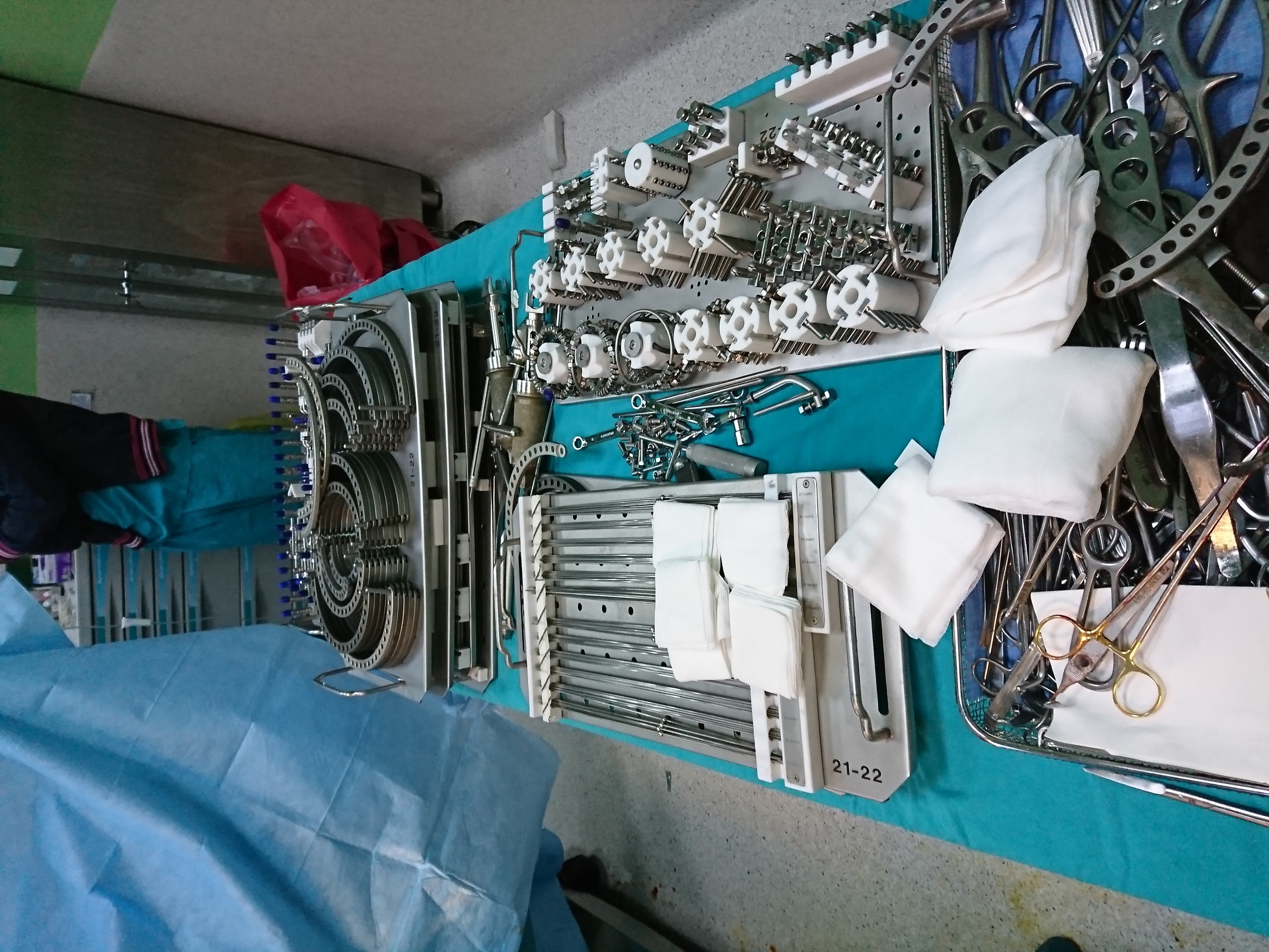
Circular (Ring) Fixators: Systems like the Ilizarov apparatus use tensioned wires and half-pins, requiring the least amount of bone length for stable fixation. They are the gold standard for gradual correction, which is safer for large deformities or when neurovascular "structures at risk" (SAR) are involved.
Hexapod Fixators: Programmable systems such as the Taylor Spatial Frame use six telescopic struts and computer software to correct all six deformity parameters (angulation, translation, rotation, and length) simultaneously in three-dimensional space.
Monolateral Fixators: These uni-planar devices are simpler to apply but are generally restricted to correcting deformities in a single plane, though they can be adapted with passive hinges or active "angulators".
3. Biological and Technical Considerations
Osteotomy Rules: The success of any fixation method depends on following geometric principles. For instance, Osteotomy Rule 1 (hinge and osteotomy at the CORA) allows for correction without translation, making it compatible with all fixation types.
Soft Tissue Integrity: Fixation methods must minimize disruption to the soft-tissue envelope. Percutaneous (low-energy) osteotomy techniques are preferred to preserve blood supply and enhance bone healing.
Lever Arm Principle: Surgeons must balance the "lever arms" on either side of an osteotomy. If fixation is limited on one side (e.g., near a joint), the strength of the hardware or auxiliary bracing must be increased to prevent failure.