Figures
Overview
Acute management aims to limit secondary injury through rapid transfer, hemodynamic support and early decompression, while preventing systemic complications. Falls are the leading cause in older adults, often producing central cord injuries in stenotic cervical spines; traffic and sports injuries predominate in young patients.
Clinical Presentation
Assessment follows ATLS principles. High cervical injuries (C3–C5) threaten diaphragmatic function and often require early intubation with manual in-line stabilization. Neurogenic shock, hypotension with bradycardia caused by loss of sympathetic tone in injuries above T6, must be distinguished from hemorrhagic shock. Spinal shock is a transient loss of reflexes below the injury; return of the bulbocavernosus reflex usually marks its end within 24–72 hours. Serial vital capacity measurements guide airway management in cervical injuries, because respiratory fatigue may develop over the first days.
The examination is documented with the International Standards for Neurological Classification of SCI (ISNCSCI), which define the neurological level and the ASIA Impairment Scale (AIS) grade (Figure 1) [1]:
• AIS A: complete; no sensory or motor function in S4–S5
• AIS B: sensory incomplete; no motor function below the level
• AIS C and D: motor incomplete; most key muscles below the level graded <3 (C) or at least half graded ≥3 (D)
• AIS E: normal sensory and motor function
Incomplete syndromes include central cord, Brown-Séquard, anterior cord and conus medullaris or cauda equina syndromes. A repeat examination at 72 hours improves prognostic accuracy.
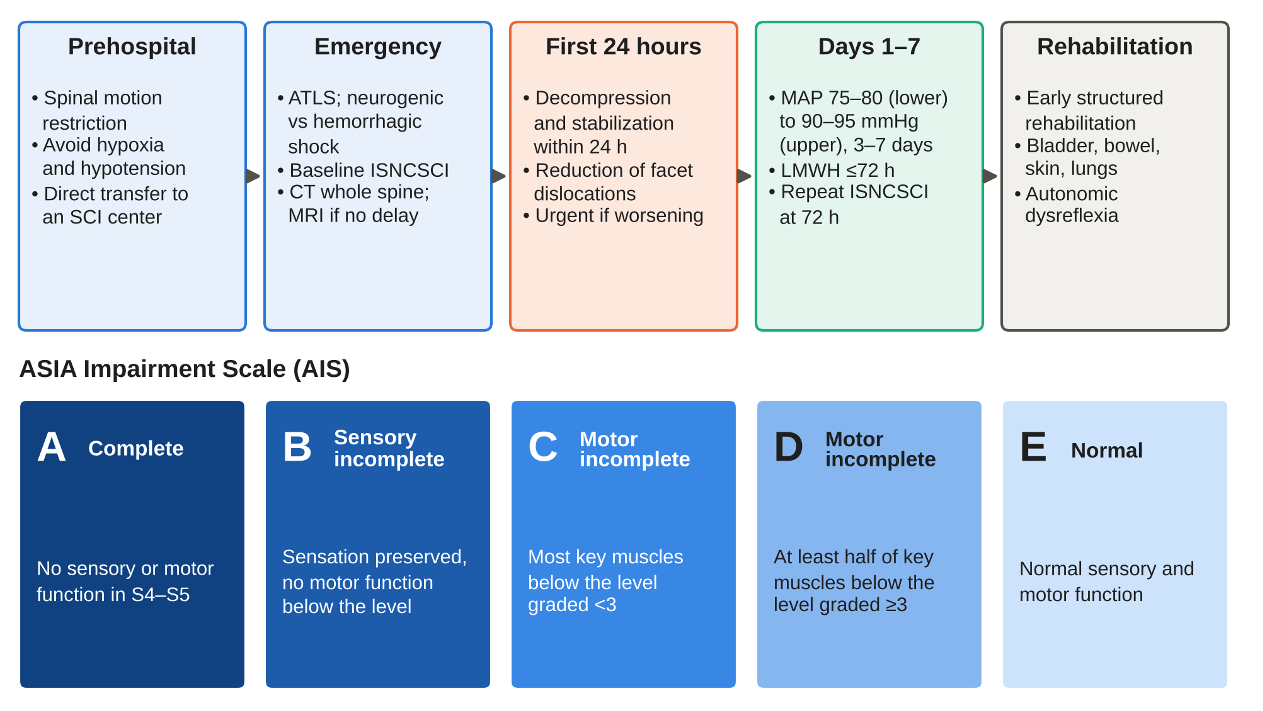
Figure 1. Acute management of traumatic spinal cord injury. Upper row: time-critical steps from the prehospital phase to early rehabilitation, including the hemodynamic and decompression targets suggested by current guidelines. Lower row: ASIA Impairment Scale (AIS) grades. ATLS, Advanced Trauma Life Support; ISNCSCI, International Standards for Neurological Classification of Spinal Cord Injury; LMWH, low-molecular-weight heparin; MAP, mean arterial pressure.
Imaging
CT of the entire spine is performed because noncontiguous injuries are common. MRI shows cord compression, edema and hemorrhage, disc herniation and ligamentous injury; axial T2 patterns and intramedullary hemorrhage carry prognostic value. MRI should not delay decompression in deteriorating patients.
In the cervical spine, the extent of intramedullary T2 hyperintensity and the axial pattern of signal change (for example, as graded by the BASIC score) correlate with neurological outcome. MRI also identifies disc herniation behind dislocated facets and epidural hematoma, both of which influence the surgical approach.
Treatment
Hemodynamic management. Hypotension must be avoided, as even brief episodes worsen cord ischemia. Updated AO Spine/Praxis guidelines suggest a mean arterial pressure (MAP) with a lower limit of 75–80 mmHg and an upper limit of 90–95 mmHg for 3–7 days, using fluids and vasopressors in an intensive care setting [2].
Decompression and stabilization. Early surgical decompression, within 24 hours, is suggested for adults with acute SCI regardless of level [3]. Closed reduction of cervical facet dislocations in awake, examinable patients can realign the canal rapidly; prereduction MRI is advised when examination is unreliable or open reduction is planned.
Pharmacological therapy. Routine high-dose methylprednisolone is not recommended. A 24-hour infusion started within 8 hours may be considered in selected adults, but use after 8 hours or 48-hour regimens should be avoided [4]. Other neuroprotective drugs and hypothermia remain investigational. Early, structured rehabilitation in a specialized SCI unit should begin as soon as the patient is stable.
Prevention of complications. Key measures include:
• Anticoagulant thromboprophylaxis, preferably with low-molecular-weight heparin, within 72 hours [5]
• Pressure injury prevention and early mobilization
• Respiratory care, including assisted coughing and early tracheostomy in high injuries
• Intermittent bladder catheterization and a bowel program
• Recognition of autonomic dysreflexia in injuries at or above T6: sit the patient upright, remove the trigger (usually bladder or bowel distension) and use short-acting antihypertensives if hypertension persists
Surgical Indications
• Persistent spinal cord compression with neurological deficit
• Unstable injuries or malalignment, such as facet dislocation or translation
• Progressive neurological deterioration (emergency)
• Central cord syndrome with ongoing compression (individualized timing)
Prognosis
The initial AIS grade is the strongest predictor of recovery. Few AIS A patients regain functional motor recovery below the injury, whereas most AIS D and many AIS C patients walk again, especially when younger. Preserved pinprick sensation in AIS B predicts better motor recovery. Most neurological recovery occurs within the first 6–12 months, and conversion of AIS A to an incomplete grade after the first few days is uncommon. Life expectancy remains reduced, mainly because of respiratory, cardiovascular and infectious complications.
References
1. Rupp R, Biering-Sørensen F, Burns SP, et al. International Standards for Neurological Classification of Spinal Cord Injury: revised 2019. Top Spinal Cord Inj Rehabil. 2021;27(2):1-22.
2. Kwon BK, Tetreault LA, Martin AR, et al. A clinical practice guideline for the management of patients with acute spinal cord injury: recommendations on hemodynamic management. Global Spine J. 2024;14(3 Suppl):187S-211S.
3. Fehlings MG, Tetreault LA, Hachem L, et al. An update of a clinical practice guideline for the management of patients with acute spinal cord injury: recommendations on the role and timing of decompressive surgery. Global Spine J. 2024;14(3 Suppl):174S-186S.
4. Fehlings MG, Wilson JR, Tetreault LA, et al. A clinical practice guideline for the management of patients with acute spinal cord injury: recommendations on the use of methylprednisolone sodium succinate. Global Spine J. 2017;7(3 Suppl):203S-211S.
5. Fehlings MG, Tetreault LA, Aarabi B, et al. A clinical practice guideline for the management of patients with acute spinal cord injury: recommendations on the type and timing of anticoagulant thromboprophylaxis. Global Spine J. 2017;7(3 Suppl):212S-220S.