Figures
Overview
The question differs for patients with spinal cord injury (SCI), patients with unstable fractures without neurological deficit and polytrauma patients. Decisions should be made jointly by the spine surgeon, trauma team and anesthesiologist, and documented.
Spinal Cord Injury
Experimental data show that persistent cord compression aggravates secondary injury in a time-dependent manner, providing the rationale for early decompression. In the prospective STASCIS cohort of cervical SCI, decompression within 24 hours was associated with higher odds of at least a two-grade AIS improvement at 6 months (19.8% vs. 8.8%) [1]. A pooled analysis of individual patient data showed better motor recovery at 1 year after decompression within 24 hours, with the benefit declining steeply over the first 24–36 hours [2].
On this basis, updated AO Spine/Praxis guidelines suggest surgery within 24 hours for adults with acute SCI regardless of level [3]. Data on ultra-early surgery (<8–12 hours) are inconsistent, and logistical pressure should not lead to unsafe surgery. The clock starts at injury, not at admission; most delays occur during transfer and imaging, so direct referral to a spine center is essential.
In incomplete cervical SCI with pre-existing stenosis and no bony injury, a randomized trial found no significant difference in motor recovery at 1 year between early and delayed surgery, although early surgery was associated with faster initial recovery [4]. Timing in central cord syndrome without instability should therefore be individualized. Early decompression is also reasonable in thoracolumbar injuries with incomplete deficits and in cauda equina compression, although the evidence is weaker than for cervical SCI.
Injuries Without Neurological Deficit
Most timing data come from observational studies prone to selection bias, because patients operated on early may differ from those operated on later; randomized trials are difficult to perform. For unstable thoracic and thoracolumbar fractures, early stabilization, generally within 72 hours, reduces pulmonary complications and intensive care and hospital stay, and may reduce mortality, particularly in polytrauma [5]. In older patients, early fixation facilitates mobilization and limits complications of bed rest. When safe, spinal fixation can be combined with other procedures under a single anesthetic. In neurologically intact patients with stable patterns, surgery, when indicated, can be scheduled semi-electively. Delaying fixation beyond the first days makes indirect reduction by ligamentotaxis less effective and may necessitate direct decompression or osteotomy.
Physiological Readiness and Polytrauma
Early definitive surgery is appropriate only after adequate resuscitation. Markers used in early appropriate care protocols, such as lactate <4 mmol/L, pH ≥7.25 or base excess ≥−5.5 mmol/L, help identify patients ready for definitive fixation [6]. In physiologically unstable patients, damage-control principles apply: temporary stabilization, for example percutaneous posterior fixation, followed by staged definitive surgery (Figure 1). Severe traumatic brain injury with raised intracranial pressure, uncorrected coagulopathy and ongoing hemorrhage are contraindications to early spinal surgery. Prone positioning increases ventilatory and hemodynamic strain, so timing must be agreed with the anesthesia and trauma teams.
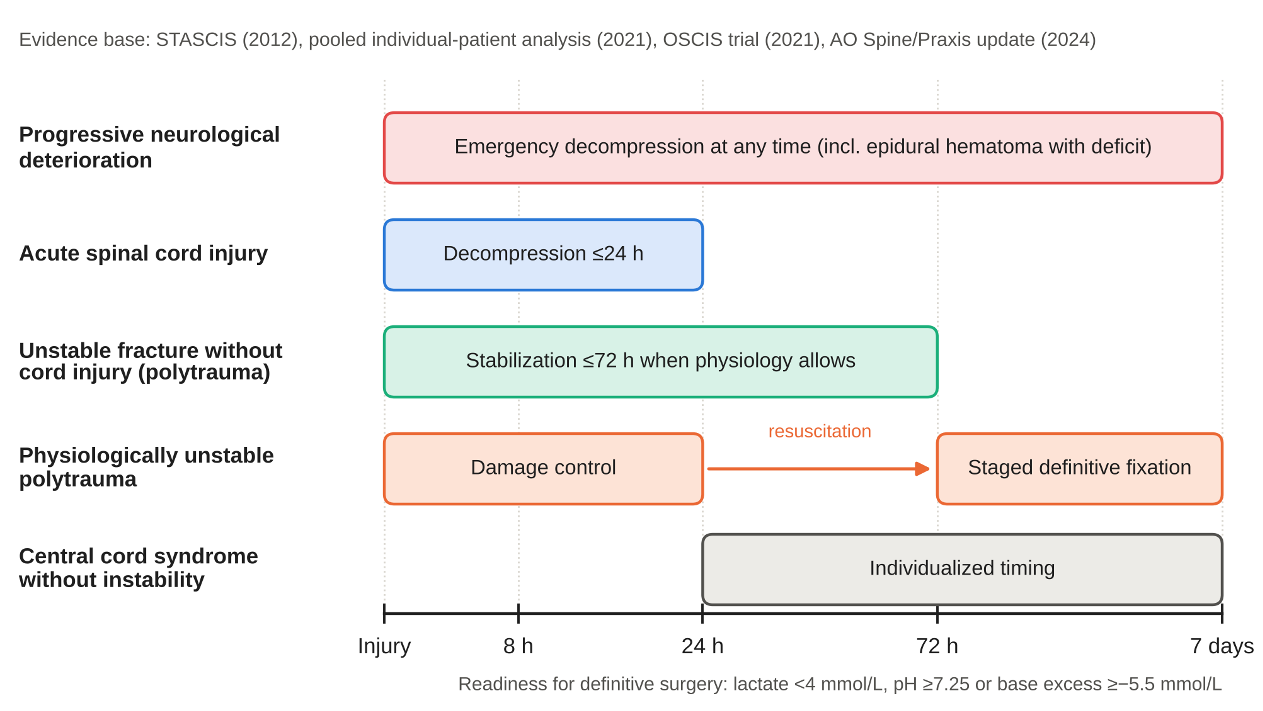
Figure 1. Timing of surgery after spinal trauma. The timeline summarizes current targets: decompression within 24 hours in acute spinal cord injury, stabilization within 72 hours for unstable fractures in polytrauma when physiology allows, and damage-control fixation followed by staged definitive surgery in physiologically unstable patients. Progressive neurological deterioration is an emergency at any time point.
Special Situations
• Progressive neurological deterioration: emergency decompression, irrespective of time since injury
• Cervical facet dislocation with SCI: urgent closed or open reduction
• Fractures in ankylosed spines: early stabilization, because displacement and epidural hematoma are common
• Epidural hematoma with a deficit: emergency evacuation
• Unstable odontoid and other fractures in older adults: early fixation, when surgery is indicated, facilitates mobilization
Practical Recommendations
• Aim for decompression within 24 hours in acute SCI and transfer patients directly to centers able to achieve this
• Stabilize unstable fractures within 72 hours when physiology allows
• Use damage-control fixation in unstable polytrauma patients
• Do not delay decompression for MRI in patients whose neurological status is deteriorating
• Individualize timing in central cord syndrome without instability
• Document the times of injury, admission and decompression to support audit and quality improvement
References
1. Fehlings MG, Vaccaro A, Wilson JR, et al. Early versus delayed decompression for traumatic cervical spinal cord injury: results of the Surgical Timing in Acute Spinal Cord Injury Study (STASCIS). PLoS One. 2012;7(2):e32037. doi:10.1371/journal.pone.0032037
2. Badhiwala JH, Wilson JR, Witiw CD, et al. The influence of timing of surgical decompression for acute spinal cord injury: a pooled analysis of individual patient data. Lancet Neurol. 2021;20(2):117-26. doi:10.1016/S1474-4422(20)30406-3
3. Fehlings MG, Tetreault LA, Hachem L, et al. An update of a clinical practice guideline for the management of patients with acute spinal cord injury: recommendations on the role and timing of decompressive surgery. Global Spine J. 2024;14(3 Suppl):174S-186S.
4. Chikuda H, Koyama Y, Matsubayashi Y, et al. Effect of early vs delayed surgical treatment on motor recovery in incomplete cervical spinal cord injury with preexisting cervical stenosis: a randomized clinical trial. JAMA Netw Open. 2021;4(11):e2133604.
5. Bellabarba C, Fisher C, Chapman JR, Dettori JR, Norvell DC. Does early fracture fixation of thoracolumbar spine fractures decrease morbidity and mortality? Spine (Phila Pa 1976). 2010;35(9 Suppl):S138-45.
6. Vallier HA, Wang X, Moore TA, Wilber JH, Como JJ. Timing of orthopaedic surgery in multiple trauma patients: development of a protocol for early appropriate care. J Orthop Trauma. 2013;27(10):543-51.